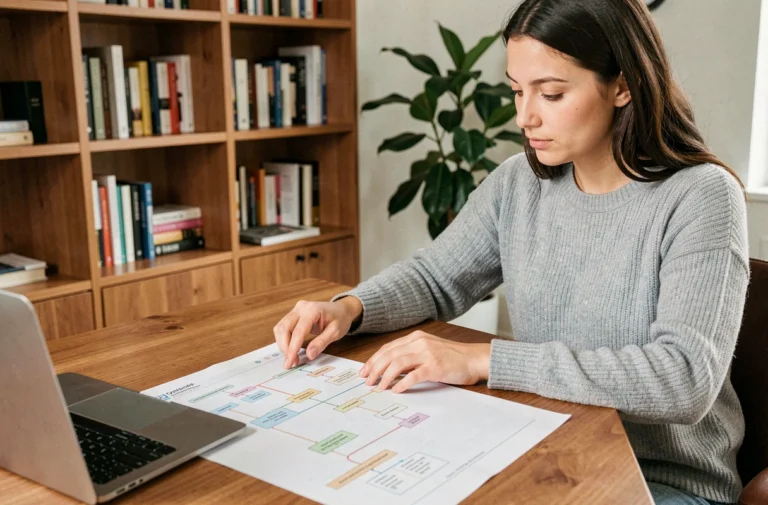
Setting up an office at home or renting a small workspace does not, in itself, guarantee good working conditions. The Dares 2024–2025 Working Conditions Survey, reported by Workinglife on November 9, 2026, reminds us that a well-designed space makes collaboration easier, but cannot make up for an unmanageable workload or unclear rules for remote work. Creating an inspiring professional space therefore means considering the setting, the way work is organized, and the real demands of everyday life together.
Air quality and noise: two invisible risks to address first
Before choosing a wall color or an adjustable desk, there are two factors no one can see but everyone feels. Noise, for one, remains a health and concentration issue even when it does not reach levels that are dangerous to hearing. A workspace overlooking a busy street or an apartment with poor sound insulation can put a strain on the nervous system over time.
Air quality, meanwhile, is rarely measured in small spaces. On October 30, 2026, Dekra highlighted the value of measuring factors such as ventilation, air quality, and noise to assess exposure objectively and prioritize preventive measures. Don’t rely solely on how the space feels or looks.
For example, a freelancer renting a ground-floor office can invest in a small CO2 monitor (costing a few dozen euros) and a smartphone sound level meter. These two tools are enough to spot a problem before it becomes chronic. That’s more useful than a high-end chair if the air is stale or the noise constant.
At Joli Rêve’s professional space, this approach—designing a place with well-being and productivity in mind—is built in from the outset, so freelancers don’t have to diagnose everything on their own.

Low-budget office setup: the compromises that can cost you
When you work alone or run a small business, the instinct is to cut costs everywhere. Some savings make sense. Others create problems that are more expensive to fix later.
Where it’s worth investing
Your chair and lighting are the two things you shouldn’t skimp on. A chair that doesn’t suit your body can cause lower back pain within weeks. Poor or badly positioned lighting strains your eyes and reduces concentration by midday.
You don’t need a chair that costs several hundred euros. A second-hand model with working lumbar support and a seat at the right height will do the job. For lighting, an adjustable desk lamp with neutral light works well alongside natural light from the side.
What can wait
- Wall decor and mood-setting touches: they contribute to psychological comfort, but a bare wall won’t hinder productivity as much as a wobbly chair
- Custom storage furniture: well-placed standard shelves are enough to start with, as long as you keep your work surface clear
- Full soundproofing: if noise levels are moderate, noise-canceling headphones cost less than acoustic wall panels and can go wherever you do
Prioritize what directly affects your body and your eyes; the rest can come later when your business allows.
Workspace accessibility: a criterion freelancers often overlook
Have you ever checked whether your workplace would be usable by someone with reduced mobility—or by you, if you had a temporary injury? Accessibility isn’t just a concern for large companies. It also matters in coworking spaces, shared offices, and workspaces rented by freelancers.
Stairs with no alternative, a doorway that’s too narrow, inaccessible restrooms: these details go unnoticed until you need them. Accessibility should also be considered in remote-work and coworking spaces. When choosing an inspiring place to work, it’s worth factoring in these criteria from the start rather than focusing only on aesthetics or lease flexibility.
If you’re renting a workspace, check the requirements that apply to establishments open to the public (ERP). Even a small space may be subject to them, depending on the activity and expected number of visitors.
How you organize your space and your work: two sides of the same project
A perfectly arranged office where you work twelve hours a day without a break is still a toxic environment. The Dares survey cited above confirms that a well-designed space is not enough without a healthy organizational framework.
For a freelancer, this might mean:
- Setting working hours in your workspace, even at home, to separate your professional and personal life
- Planning a way to switch off (moving to another room, closing the office door, turning off the screen) to mark the end of the workday
- Matching the space to the task: a quiet corner for focused work and another for calls or video meetings, even if they’re just two differently oriented areas in the same room
Your physical environment and working practices reinforce each other. A space designed for quiet loses its effect if you allow constant interruptions.
Larger workspaces
For businesses occupying commercial premises, the Eco Energy Tertiary Decree applies to buildings or groups of buildings used for commercial activities covering at least 1,000 m². This threshold does not affect most freelancers, but it may apply to a coworking space or premises shared by several businesses. Find out about the building’s energy requirements before signing a lease.
A workspace that feels pleasant in summer can turn into a furnace if the landlord hasn’t installed a compliant ventilation system—or into a poorly insulated space in winter that drives up your bills.
The most inspiring professional space is one that delivers on its promises every day. Not one that looks impressive in a photo, but one where noise is manageable, the air is fresh, the chair fits, and working arrangements are clear. Start by measuring before you decorate.