
A motorcycle that exceeds the noise threshold listed on its registration document or emits non-compliant gases is no longer just a neighborhood issue. With the implementation of motorcycle technical inspections and the gradual deployment of noise cameras in urban areas, excessively loud or polluting two-wheelers are effectively losing their right to circulate freely. Making your motorcycle quieter and cleaner is now a measurable technical constraint, not an aesthetic choice.
Motorcycle technical inspection and noise measurement: what has changed since 2024
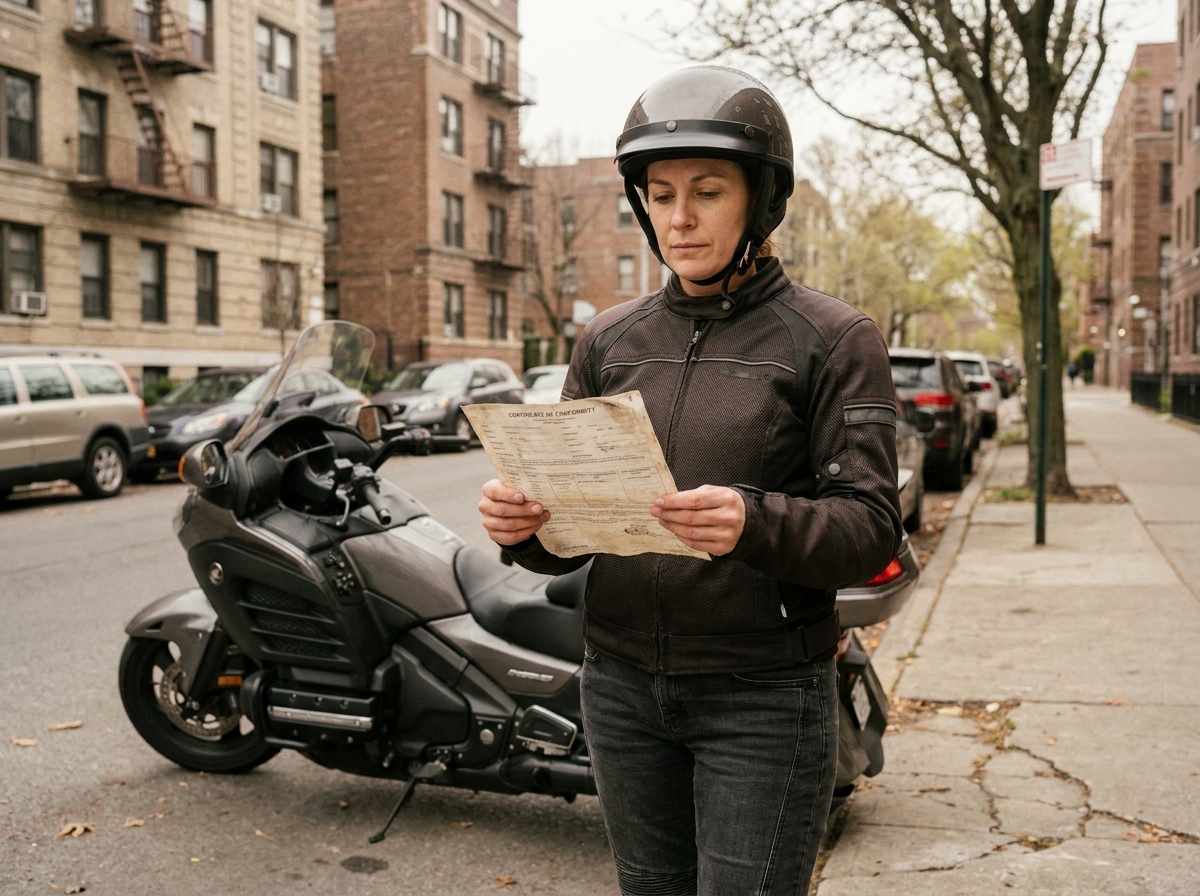
The motorcycle technical inspection, which began to be implemented in April 2024, includes a systematic measurement of noise levels. The technician measures the decibels at the exhaust and compares them to the value listed on the vehicle’s registration document. A tolerance of 5 dB is applied above this homologation value.
In case of exceeding this limit, the result is a re-inspection. The motorcycle cannot obtain its certificate until the noise level is brought back within the acceptable range. In practical terms, an unapproved aftermarket exhaust or degraded fiberglass is enough to fail the inspection.
This point is distinct from traditional roadside checks. During a technical inspection, the measurement is standardized, reproducible, and the result remains in the vehicle’s file. A motorcycle identified as too noisy will have to return to an approved center after mechanical intervention. The question of motorcycle insurance also arises, as some insurers check the vehicle’s compliance before accepting a claim related to an unapproved modification.
Noise cameras in the city: the 85 dB threshold and its current limits
A ministerial decree dated July 7, 2023, set a threshold of 85 dB(A) for vehicles operating on certain urban roads limited to 50 km/h. Sensors have been installed and tested in several cities, including Paris. The principle: a directional microphone identifies the offending vehicle and triggers a fine.
The technology works. However, the automation of fines is still not fully operational by mid-2026. The final approval of the devices and the consolidation of the legal framework necessary for automatic sanctions are still in progress.
This delay creates an ambiguous situation. The risk of automatic fines is still low, but the technical system is in place. The day the approval is finalized, fines could be issued without human oversight, just like speed cameras. Waiting for that moment to address the noise of your motorcycle is akin to preparing for a re-inspection the day before the technical inspection.
Exhaust line and approved silencer: the main lever
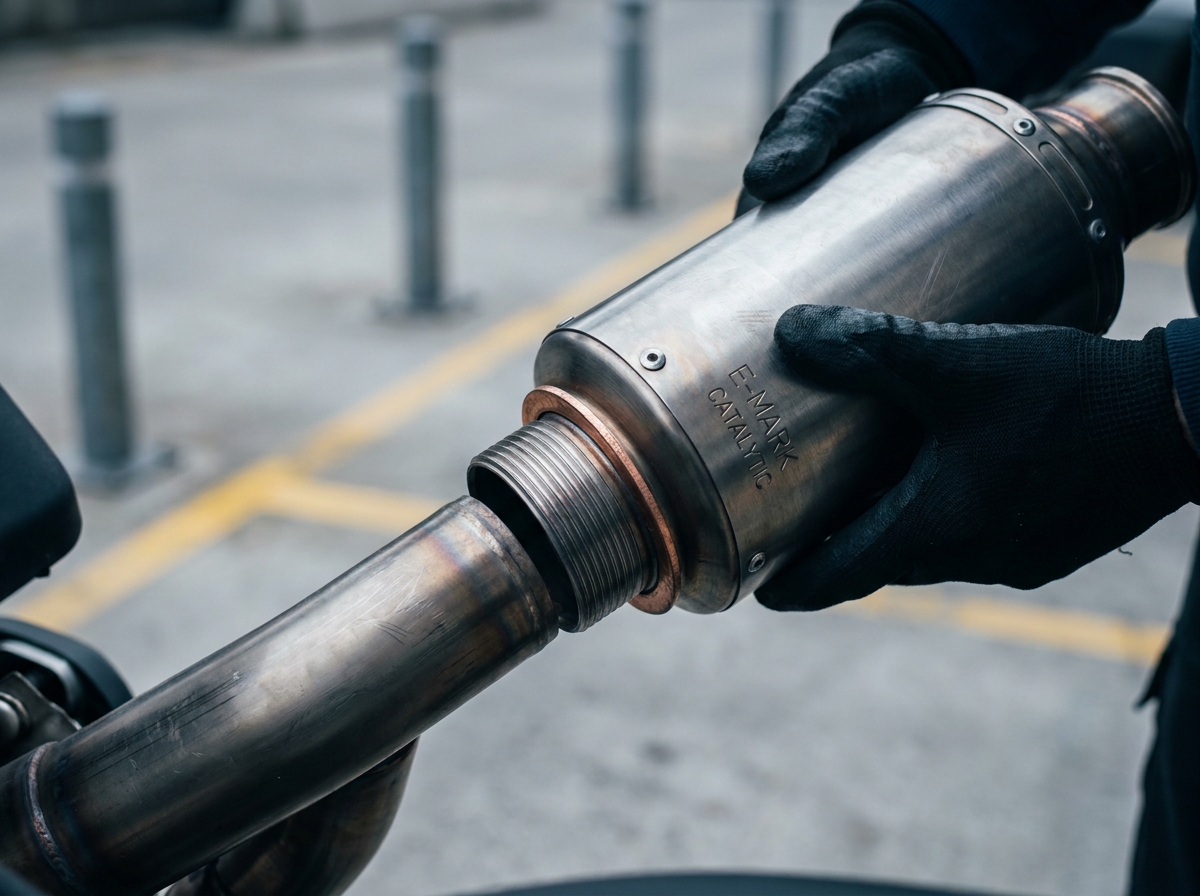
The main source of noise from a motorcycle remains the exhaust line. Replacing a free or degraded silencer with a approved silencer is the most effective intervention to reduce noise levels by several decibels.
Three points deserve special attention when choosing:
- Compatibility with the exact model of the motorcycle, including the year of manufacture. A silencer designed for a different model year may not provide the same sound attenuation or gas flow.
- The presence of the “E” marking followed by a number, which certifies European homologation. Without this marking, the silencer will fail the technical inspection and expose the rider to a fine in the event of a roadside check.
- The condition of the internal fiberglass. Even an approved silencer loses effectiveness when this absorbent material compresses or disintegrates over time. Regular replacement of this lining restores original attenuation.
A complete exhaust system (header + silencer) offers greater gains than a simple slip-on, but its cost is significantly higher. For most stock motorcycles, replacing just the silencer is sufficient to fall back under regulatory thresholds.
Euro 5 anti-pollution standards and low emission zones
The “clean” aspect of the equation concerns pollutant emissions. New motorcycles sold in Europe must comply with the Euro 5 standard, which regulates emissions of carbon monoxide, unburned hydrocarbons, and nitrogen oxides. Older motorcycles, subject to previous standards (Euro 3 or Euro 4), emit more pollutants per kilometer.
Low emission zones (LEZ) are multiplying in major French urban areas. These zones restrict the circulation of the most polluting vehicles based on their Crit’Air sticker. A motorcycle classified as Crit’Air 3 or higher risks being banned from these areas during the relevant hours.
In practical terms, a Euro 3 motorcycle registered before 2007 receives a Crit’Air 3 or 4 sticker. The most restrictive LEZ may gradually exclude these vehicles. Checking your Crit’Air classification and anticipating local restrictions helps avoid unpleasant surprises when traveling in the city center.
Regular maintenance and its impact on noise and emissions
Before investing in new parts, rigorous maintenance already addresses part of the problem. A poorly tuned engine produces more mechanical noise and emits more pollutants than a well-maintained engine.
- Worn exhaust manifold gaskets create audible sound leaks even at idle. Their replacement is inexpensive and eliminates unwanted whistling.
- A clogged air filter enriches the air-fuel mixture, increasing unburned hydrocarbon emissions and potentially altering engine speed to amplify noise.
- Out-of-tolerance spark plugs cause irregular combustion, leading to knocking and excessive fuel consumption.
- Chain tension, often neglected, generates a distinct knocking noise that adds to the exhaust noise during overall measurements.
Up-to-date maintenance reduces noise and emissions without any modifications to the motorcycle. It is also the first point implicitly checked during the technical inspection, as the result of the noise measurement depends on the overall condition of the mechanics.
Motorcycles currently operating within a stable legal framework will soon need to comply with more frequent inspections and stricter geographical restrictions. Addressing the silencer, engine maintenance, and Crit’Air classification covers almost all blocking points. The cost remains moderate compared to that of forced immobilization or repeated fines.