
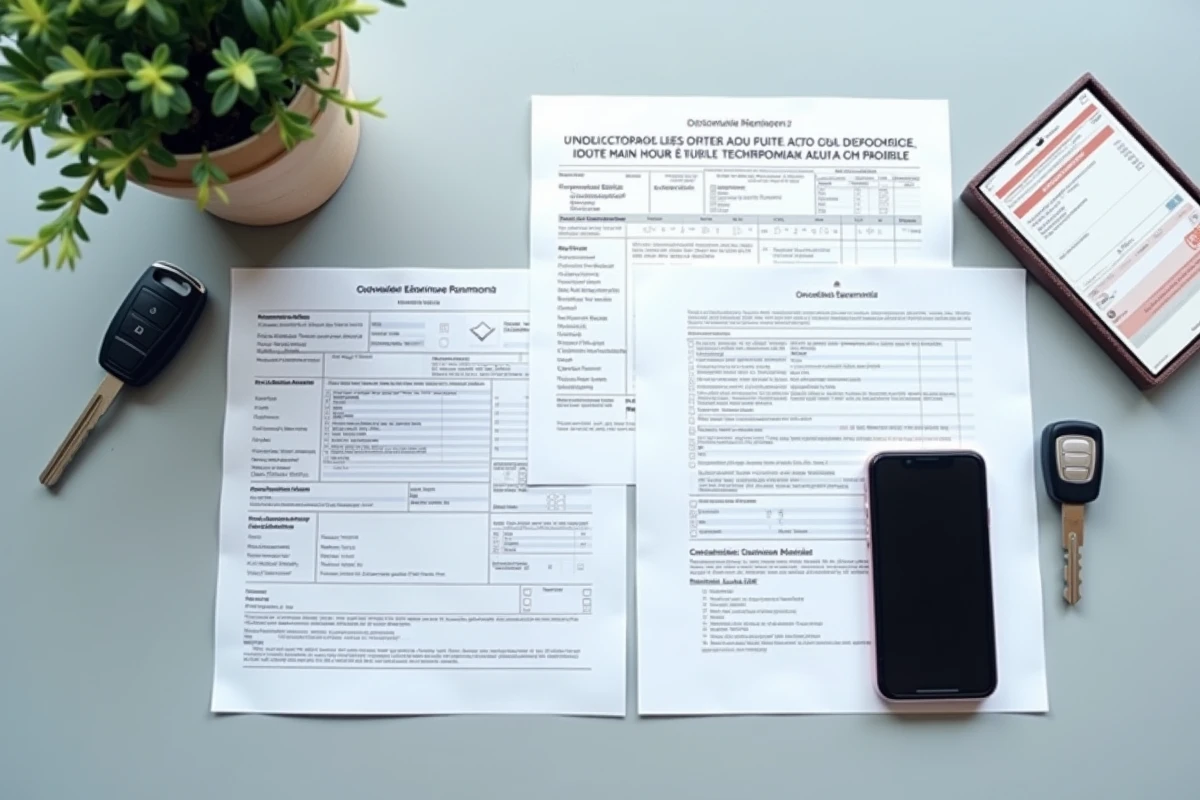
Insurance, registration certificate, technical inspection: three distinct documents, three different deadlines, three interfaces with no connection between them. The management of car papers remains fragmented for the majority of French motorists. Between the ANTS website for registration, the insurer’s client space, and the approved center for technical inspection, each process adheres to its own rules and timelines.
Measuring the actual cost of this dispersion, in terms of time and risks, helps identify the most concrete simplification levers.
Deadlines and channels: what each process really imposes
The three administrative documents related to the vehicle do not follow the same circuit. Comparing their respective constraints highlights the friction points that motorists experience without always identifying them.
| Document | Main Channel | Average Processing Time | Renewal Frequency |
|---|---|---|---|
| Registration certificate (carte grise) | ANTS / authorized SIV professional | Variable depending on the complexity of the file | With each change of owner, address, or vehicle characteristic |
| Auto insurance certificate | Insurer (online or agency) | Immediate to a few days | Annual (tacit renewal or cancellation) |
| Technical inspection | Physical approved center | Result on the same day | Every two years after the fourth year of the vehicle |
The registration certificate concentrates most of the irritants. Since 2017, all requests for a carte grise must be made electronically, via the ANTS website or an authorized professional in the Vehicle Registration System (SIV). Prefecture counters no longer exist for this process.
As detailed in the article on autofantom fr from Blog Automobile, some platforms attempt to consolidate these scattered processes within a single interface, reducing the number of contacts to manage.
Insurance, on the other hand, remains the simplest document to obtain and renew. Tacit renewal prevents forgetfulness, but it masks a risk: that of maintaining a contract unsuitable for the vehicle or actual use.

Concrete risks of fragmented vehicle document management
Forgetting a deadline or misplacing a document is not just a minor inconvenience. The consequences vary depending on the document concerned, and some are more severe than one might assume.
- Expired technical inspection: driving without a valid technical inspection exposes one to a fixed fine and possible immobilization of the vehicle during a roadside check.
- Registration certificate not updated after a move: the holder has one month to report their change of address. Beyond that, a fine is incurred.
- Insurance certificate absent from the vehicle: even if the contract is active, the absence of the document during a check leads to a fine.
- Total lack of insurance: the penalty is significantly harsher, with possible criminal consequences.
The common point of these situations is the difficulty in tracking several distinct calendars. The technical inspection follows a biennial cycle. Insurance renews annually. The registration certificate has no fixed periodicity but requires updates at each event (sale, move, modification of the vehicle).
Digitization of car processes: what works and what blocks
Online registration certificate via ANTS
The Simplimmat portal, developed by France Titres (formerly ANTS), allows for almost all operations related to registration. Change of holder, request for a duplicate, declaration of transfer: everything goes through this single channel.
The system works, but it requires an active ANTS account, compliant digitized supporting documents, and a stable connection. For users who are not comfortable with digital tools, France Services points offer in-person assistance.
Towards a digital registration certificate in the European wallet
Digitization does not stop at the application process. The regulation (EU) 2024/1183, adopted in April 2024, sets the framework for the European Digital Identity Wallet. This system allows for the storage and presentation of official documents, including vehicle-related documents, according to the choices of each member state.
France has not yet integrated the registration certificate into this wallet, but the regulatory trajectory is set. Ultimately, the paper document could be replaced by a digital document with the same legal value.
Technical inspection and reading of onboard data
The technical inspection is evolving as well. In 2024, the European Commission initiated a revision of the regulatory package on roadworthiness. The focus is on access to the vehicle’s onboard data to detect possible software manipulations or fraud in driver assistance systems.
This evolution mainly concerns recent connected vehicles, but it signals a technical inspection that is increasingly less based solely on visual inspection.
Fleet management and document compliance: a professional challenge
The centralization of car documents is not only relevant for individuals. For fleet managers, tracking insurance, technical inspection, and registration deadlines for dozens or hundreds of vehicles represents a full-time job.
Recent automotive document management tools are positioning themselves in this professional niche with specific features:
- Probative archiving of certificates and attestations
- Automatic alerts before a document expires
- Secure sharing between driver, manager, and insurer
- Complete history exportable upon vehicle resale
This market for centralized automotive documentation is gradually aligning with that of regulatory compliance tools, with traceability requirements that go beyond simple PDF file storage.
The fragmentation of car processes remains the main barrier to smooth management, whether one owns a single vehicle or a complete fleet. European regulatory developments outline a model where registration certificates, insurance, and technical inspections will converge in a unified digital space. Until then, consolidating documents and automating the tracking of their deadlines remains the most effective lever to avoid costly oversights.